
Daniel G. Andújar
The 61st Venice Art Biennale has just opened its doors, and it is already operating as an institution in a state of emergency. Before the public had even begun to stroll through the Giardini and the Arsenale as usual the 2026 edition was already rife with resignations, boycotts, shuttered pavilions, artists sacked and reinstated, absent countries, European funding under threat, mass protests, and the first strike in its 131-year history. What had long presented itself as the great Olympics of art has become the stage of its own decomposition.

The 2026 Venice Biennale demonstrates that the model of national representation born in the nineteenth century has come to an end. It isn’t broken: it is functioning exactly as it was designed, but in a world that no longer tolerates the fiction. What is collapsing is not a difficult edition of the biennial. It is the model itself: the old diplomatic architecture of national pavilions, the fiction of institutional neutrality, the idea that art can operate as a zone of truce while the very states that finance, name and represent it wage wars, carry out ethnic cleansing, censor at home and run cultural propaganda campaigns. The Biennale does not reflect a world in crisis. It administers it and puts it on display as a symptom.
The central exhibition, In Minor Keys, arrives marked by an absence that runs through the entire reading of the show. Its artistic director, Koyo Kouoh, died in May 2025. Her team has brought to completion a posthumous vision oriented towards listening, healing, physical and spiritual rest, low frequencies, and oases of care. A Biennale that avoids overtly political art and seeks other forms of symbolic repair. On the threshold of the Arsenale, the curatorial team inscribes If I Must Die, the poem by Refaat Alareer, the Palestinian writer killed in Gaza in 2023. The gesture set an ethical frame before the exhibition had even begun. But the institutional apparatus that surrounds that threshold swallows it.
The Biennale calls for silence while everything around it is screaming. It speaks of pause while Gaza, Ukraine, Lebanon, Iran, Sudan, and the far-right international run through every conversation in the corridors. It proposes minor keys at a moment of deafening historical noise. The question is not whether rest is necessary. It is. The question is who gets to rest, under what conditions, inside which institution, and at whose expense. In a Biennale sustained by states, elite tourism, luxury brands, and precarious cultural labor, the language of care risks becoming an anesthetic, no matter how long Alareer’s verse remains on the wall.
The controversy broke open when the international jury resigned en masse just days before the opening. Its position is unambiguous: it will not evaluate or award prizes to representatives of states whose leaders have been charged or are being prosecuted by the International Criminal Court for war crimes or crimes against humanity. The reference points directly at Russia and Israel. The institution, unable to hold that conflict, responded by cancelling the traditional prize system and improvising a public-vote award, the so-called Visitor Lion. It then postponed the Golden Lion ceremony to 22 November, the closing day of the Biennale. In other words, it relocated critical judgement to the end of the event, when it would no longer have any political effect. The manoeuvre resolved nothing. It turned an ethical crisis into a mechanism of tourist participation.
The artists’ response was immediate. Dozens withdrew their works from the competition. The prize was left symbolically empty. When an institution no longer knows how to decide, it delegates to an interface. When critical judgement becomes dangerous, it is replaced by a poll. The problem does not go away. It becomes more visible.
From that point on, the Biennale stopped being a map of countries and became a map of conflicts. Russia is not only Russia: it is the war in Ukraine and the normalisation of imperial aggression. And its return to Venice, far from being an administrative formality, was negotiated in secret from June 2025 by commissioner Anastasia Karneeva, daughter of a senior Rostec executive and FSB general. Internal correspondence leaked by La Repubblica revealed strategies for getting around European sanctions through pre-recorded performances, along with active logistical support from the Biennale’s own management in securing Italian visas for the Russian pavilion’s curator. The European Commission has threatened to withdraw two million euros in funding and described the Russian participation as a “propaganda mechanism” incompatible with the sanctions regime. The Biennale claims it is the UN of art, open to any state recognized by Italy. The documents suggest something else: a parallel, anticipatory, discreet diplomacy. Israel is not only Israel: it is Gaza, the accusation of genocide, the Western diplomatic shield, and the dispute over the limits of cultural boycotts; it becomes the epicenter of the mobilizations against artwashing. Iran is not only an absence; it withdraws quietly, leaving a gap that signals the impossibility of separating culture from the military escalation in the Middle East. Lebanon is not only a place of origin; it is a zone of suspicion projected onto artists’ bodies and biographies, as shown by the case of Khaled Sabsabi, selected to represent Australia, dismissed, and later reinstated after a controversy over earlier works featuring images of Hezbollah. The work stops being read as work and starts operating as a file.
The United States did not escape the discomfort either, but its case has its own texture. The National Endowment for the Arts has seen its funding cut under the new Trump administration. The University of South Florida, originally tasked with coordinating the country’s representation, collapsed bureaucratically. The handover went to an opaque body, the American Arts Conservancy, headed by a businesswoman from the pet food sector. The selected artist, Alma Allen, is exhibiting under conditions that have less to do with a national pavilion than with a privatized emergency commission. Beyond the individual case, the detail sketches an architecture: a far-right cultural offensive that no longer limits itself to attacking museums from the outside but hollows institutions out from within and repopulates them with figures from the corporate field. Culture is another front in the identity war. Trumpism understands the value of these spaces very well. It does not want to abandon them. It wants to occupy them. It wants to discipline institutions, turn artistic freedom into propaganda for national values, and reinstate an authoritarian idea of cultural prestige. What we are watching in Venice is the international rehearsal of that operation.
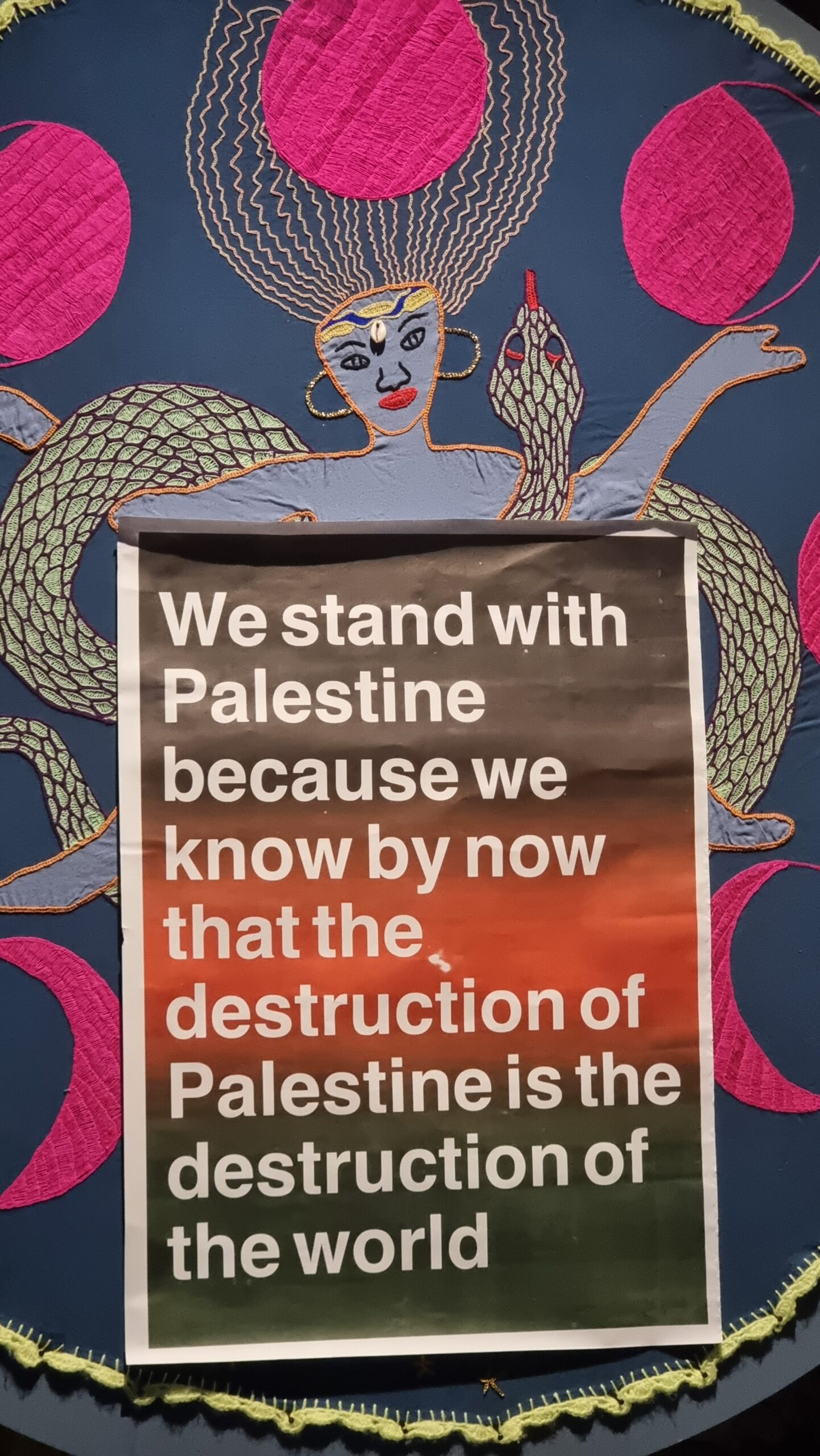
The protest did not emerge spontaneously or in disarray. It had logistics, political memory, infrastructure. The organizing work of ANGA, Sale Docks, Morion, Biennalocene and Taring Padi proved decisive in turning unease into coordinated action. ANGA denounced artwashing and demanded the exclusion of the Israeli pavilion. Sale Docks and Morion brought an accumulated Venetian experience of self-management, cultural trade unionism, political occupation and territorial organizing. Biennalocene introduced the ecological concerns and the critique of the event’s own extractive model. Taring Padi added a genealogy of militant graphic work, collective art and international solidarity. Thanks to this network, the protest was not reduced to gesture. It became a viable structure.
The 8 May strike marked a turning point. It was not a protest against a single pavilion. It was a challenge to the Biennale’s entire infrastructure. Pavilions were shut down, openings were delayed, performances were suspended, installations were intervened in. Palestinian flags appeared, posters, pickets, bodies blocked the normal stroll through the event. A substantial share of the national pavilions was affected. For the first time in 131 years, the Biennale faced a strike on this scale.
And then something decisive happened. The strike shifted the gaze. It was no longer only about the artist as authorial figure or the curator as intellectual mediator. The workers who hold the machinery up came into view: mediators, installers, security staff, technicians, assistants, gallery attendants, translators, producers, cleaners and transporters. The great global exhibition revealed itself for what it always was and is almost never named: a fragile, precarious, outsourced labor infrastructure. The glamour of the opening week rests on a material base that normally remains invisible. The strike made it visible.
While the state model sinks into its own contradictions, another power moves forward with considerably greater stability. Private capital does not wait. And it deserves to be named precisely, because confusion serves the apparatus itself. When national pavilions close due to pickets or boycotts, the corporate foundations do not suffer. They program. While the state loses legitimacy, they gain ground, budget and agenda. The public crisis is their private opportunity.
The Fondation Pinault now operates as a power parallel to the Biennale: two permanent venues in Venice, Palazzo Grassi and Punta della Dogana, year-round programming, a budget that doubles that of many pavilions, and a curatorial line that sets international agenda without going through any public decision. Bulgari has negotiated its appointment as Exclusive Partner of the International Art Exhibition into the next decade, locking in the rights for the 2026, 2028 and 2030 editions. This is not sponsorship: it is institutional integration. Corporate capital becomes inscribed in the Biennale’s machinery, funding restorations, prizes and events that embed themselves in the official calendar until they become indistinguishable from the program itself. Prada produces, through its Fondazione, a sophisticated curatorial discourse that quickly metabolizes the critical languages of the moment, from ecology to decolonization. Patrizia Sandretto has gone one step further: in 2026 she inaugurated her third permanent site by buying and rehabilitating an entire island in the northern lagoon. This is no longer about renting palaces. It is about privatizing ecosystem. And all of it under the language of the climate emergency, which private capital uses to rewrite the cultural geography of the city. TBA21 does something equivalent on the symbolic plane: through Ocean Space, in the church of San Lorenzo, it is presenting a project this year on the repatriation and restitution of objects looted from Indigenous communities. It thereby captures, in philanthropic key, one of the debates currently fracturing Europe’s state museums, and hands it back framed as a benevolent initiative of corporate capital. They are not patrons. They are the new cultural sovereigns, with their own diplomacy, institutional access and palaces. And the state, far from containing them, opens the doors wide: the recent concession of a pavilion to Qatar for ninety years in exchange for forty million euros confirms that sovereignty in the lagoon is now traded on a market.
The success of this operation lies not in its economic volume, which also counts, but in its tone. Privatization does not arrive in reactionary aesthetics. It arrives with progressive vocabulary, impeccable lighting and sophisticated mediation. That is where its power lies. Where the state appears clumsy, violent, censorious or paralysed, private capital presents itself as flexible, cosmopolitan and sensitive. It does not need to raise a flag. Producing atmosphere is enough. It does not censor: it metabolizes. It turns conflict into programming, criticism into reputation, historical injury into symbolic capital. And it does so, moreover, with the signatures of some of the most prestigious curators in the field, which shields the operation from any suspicion of opportunism.
The Biennale is thus split between two forces that no longer admit synthesis. On one side, an artistic, labor and militant base demanding material accountability from institutions, refusing to share a platform with states accused of atrocities, and understanding culture as a real field of conflict. On the other, a corporate machinery that absorbs crises and returns them as high-end aesthetic experience. Between the two, the old cultural diplomacy is crumbling without anyone really defending it.
Venice 2026 is not failing because politics has invaded art. It fails because institutional art spent far too long pretending it could administer politics without getting its hands dirty. The national pavilion, the international prize, the luxury patronage, the VIP week, cultural tourism and the rhetoric of neutrality are all part of the same apparatus. This edition did not destroy it. It made it visible.
That is why the 61st Biennale will be remembered less for its works than for its interruptions. The jury that walked out. The secret diplomacy with Moscow. The Golden Lion postponed to the last day. Iran disappearing from the map. Israel turned into the epicenter of the boycott. Lebanon read under suspicion. The United States hollowed out and reoccupied by the Trumpist offensive. Qatar buying sovereignty for ninety years. The artists who withdrew their names. The workers who stopped work. The collectives that organized. The flags that broke into the white cube.
The Biennale is not over. It has barely begun. But something essential has already been laid bare. The institution can no longer claim legitimacy on the basis of a political and legal design from the past. Neutrality has run its course as an alibi. What we will see in the coming weeks is not a debate about contemporary art. It is the dispute over who defines what global culture is: the organized pressure of those who interrupt the machinery, or the capacity of capital to absorb everything without breaking a sweat.
Meanwhile, Alareer’s poem remains on the threshold of the Arsenale, a reminder that minor keys are no longer enough.
In Venice, that conflict is no longer outside the exhibition. It is the exhibition.
Related Images:


Leave a Reply